Databricks has built an Excel add-in.
Here is an honest look at what that means.
On March 2, 2026, Databricks released its own Excel connector into Public Preview. We think it is worth examining clearly — including where it competes well and where it doesn’t.
Exponam, LLC · March 2026
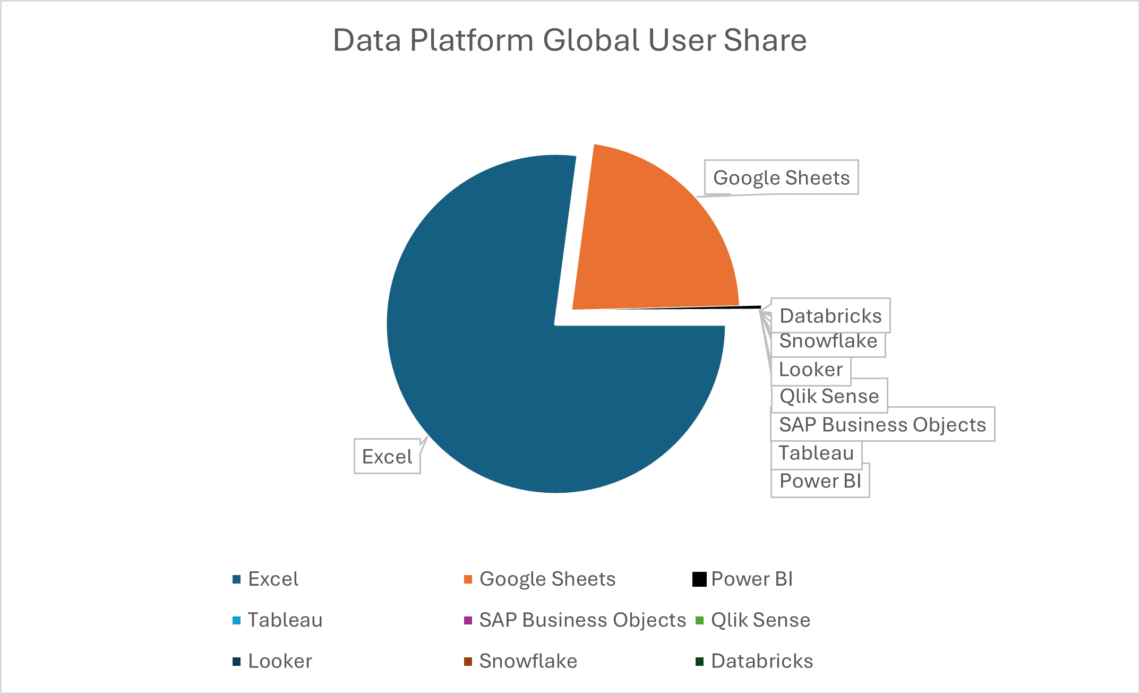
Databricks entering the Excel connectivity market is meaningful market validation. It confirms what Exponam has built a company around: governed, business-user access to lakehouse data from Excel is not an edge case or a transitional requirement. It is a permanent, strategically important capability that enterprises need.
We have spent three years in production enterprise deployments solving exactly this problem. Databricks has spent considerably more on engineering and market resources than we have. So we want to give an honest account of where the new product performs, where it falls short, and what the right choice is depending on your situation.
What Databricks built
The Databricks Excel Add-in uses the SQL warehouse endpoint — the same compute layer that powers Databricks SQL notebooks and BI tool connections — to query data and return results into Excel. Users browse Unity Catalog, apply filters, and import data into worksheets through a task pane interface. They can also write SQL directly using =DATABRICKS.SQL() cell functions. Unity Catalog governance applies throughout. The product is a web-based Office Add-in, running on Windows, macOS, and Excel for the web using the same cross-platform JavaScript framework.
For a first-version public preview, it is a credible product. It will serve some organizations well — particularly small teams already operating inside a Databricks workspace who need occasional data in a spreadsheet.
Where Exponam.Connect is different
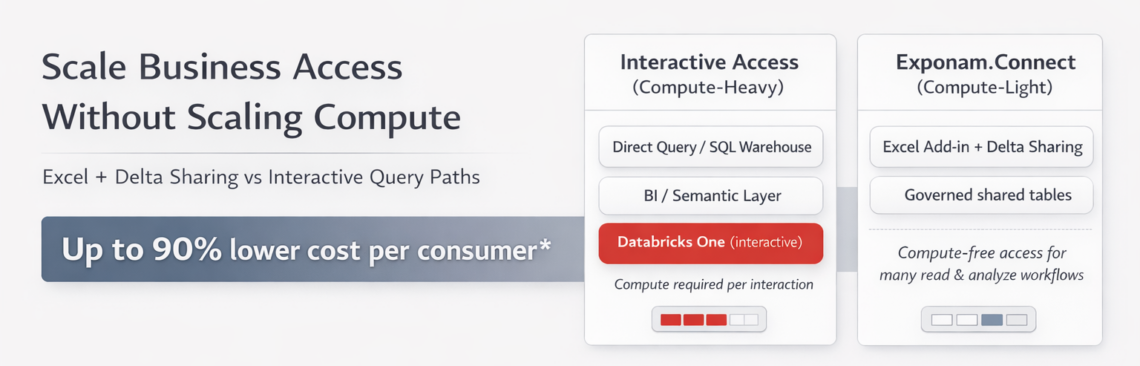
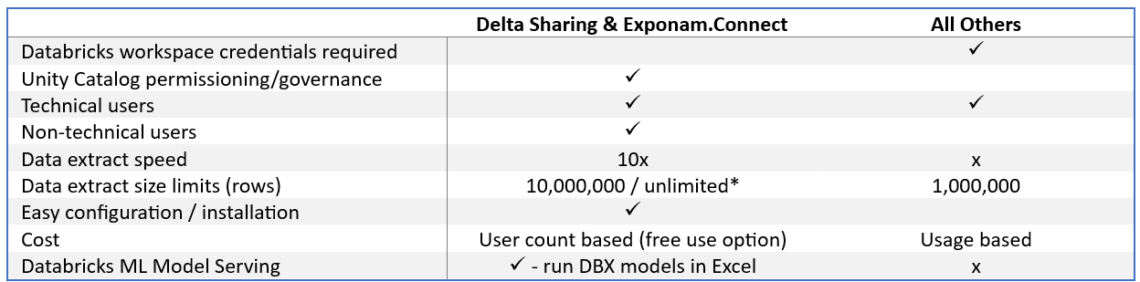
The foundational architectural difference is the data retrieval path. Exponam.Connect offers users a choice: access data via Delta Sharing — the open protocol that retrieves compressed Parquet files directly from cloud object storage, bypassing Databricks compute entirely — or via a SQL warehouse endpoint when full SQL syntax is required. The SQL endpoint path, currently in private preview, gives users arbitrary joins, window functions, and subqueries. The Delta Sharing path gives them speed and zero compute cost.
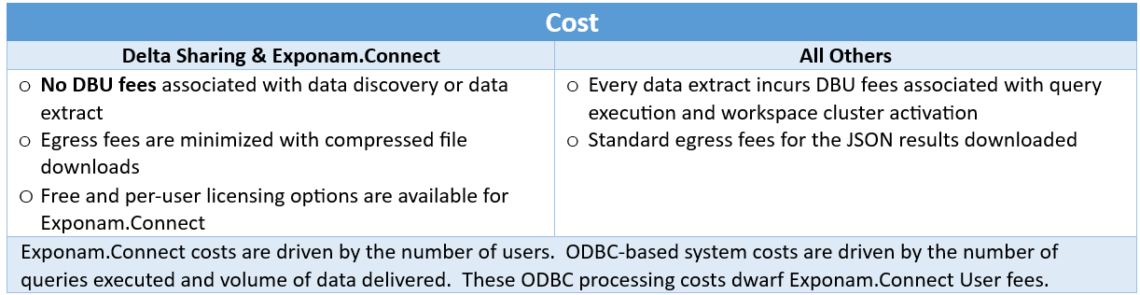
Databricks’ add-in uses the SQL endpoint only — there is no zero-compute access mode. Every data pull consumes DBUs.
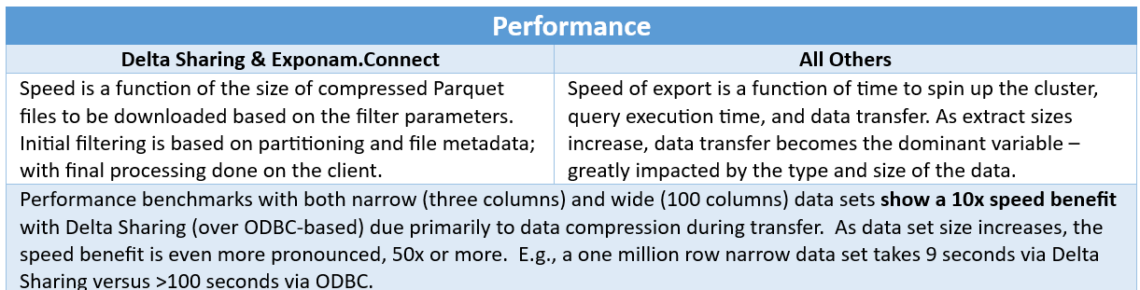
On Windows, Exponam.Connect uses the VSTO framework — the native Microsoft COM-based integration layer — rather than the web-based Office Add-in model Databricks uses on all platforms. The practical result: data writes into Excel are significantly faster for large datasets, as the trial results below demonstrate.
A direct comparison
The table below covers the dimensions that matter most in an enterprise evaluation. We have tried to be accurate about both products, including areas where they are genuinely equivalent or where Databricks holds an advantage.
| Dimension | Exponam.Connect | Databricks Excel Add-in |
|---|---|---|
| Installation | Installer link at exponam.com. Under five minutes to first data access. ▲ Exponam advantage |
Download manifest XML → edit file → create shared folder → configure Trust Center → restart Excel. 10+ steps; fails silently in many corporate IT environments. Author completed installation after multiple attempts and substantial troubleshooting. |
| Data retrieval | User choice: Delta Sharing (zero DBUs, direct Parquet from cloud storage) or SQL endpoint (full SQL syntax, compute consumed). Both Unity Catalog governed. ▲ Exponam advantage |
SQL warehouse endpoint only. Every import consumes DBUs. |
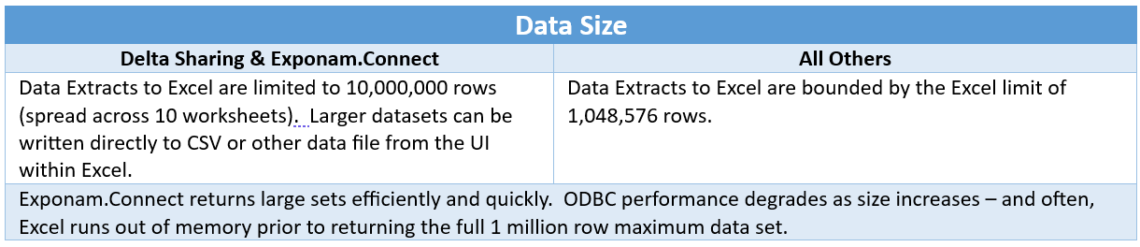
| Performance & data volume | ~11 seconds per 1M rows on Windows. Full 2,879,789-row trial dataset retrieved successfully via both Delta Sharing and SQL endpoint paths. ▲ Exponam advantage on Windows |
No published benchmarks. Trial testing returned 948,650 rows from the same 2.88M-row dataset before producing a non-descriptive error. SQL warehouse cold-start adds 2–5 min for non-serverless configurations. ▲ Data volume limit not documented; validate before deployment |
| Cost structure | Transparent, volume-tiered license: $10/user/month at 100 users, scaling to $0.50/user/month at 100,000. Fixed and predictable. ▲ Exponam advantage at scale |
No add-in license fee. But trial testing observed 16 DBU ($14.58) consumed in a single day of casual analyst use. At 5 DBU/day average, that is ~$70/user/month at list rate. ▲ Databricks advantage for very small teams only |
| SQL query | Dynamic SQL editor (private preview) via SQL endpoint. Unity Catalog Views always available. — Parity achieved |
SQL query editor in task pane; =DATABRICKS.SQL() and =DATABRICKS.Table() cell functions. |
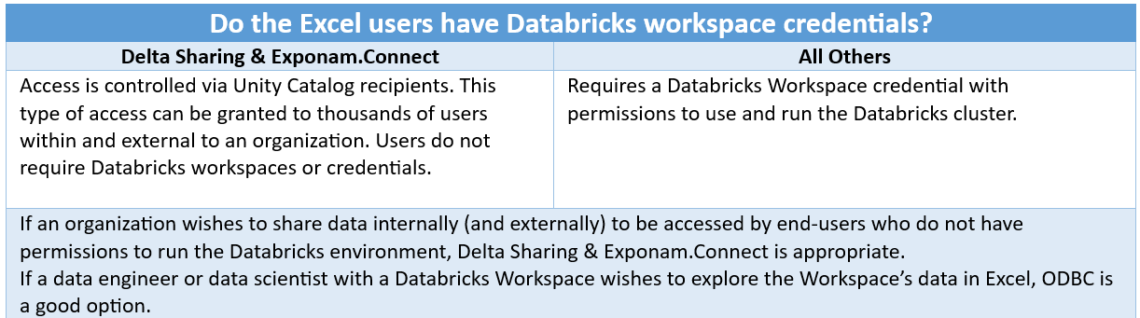
| External access | .share files work without Databricks workspace accounts. Partners and clients access governed data without workspace provisioning. ▲ Exponam advantage |
Requires a Databricks workspace account for every user. |
| ML model execution | Exponam.AI runs Databricks ML Serving Endpoints as native Excel formulas. (Windows/VSTO edition only.) ▲ Exponam advantage — no equivalent |
Not available. |
| UC governance | Full UC governance on both Delta Sharing and SQL endpoint paths. | Full UC governance. — Parity |
| Metric Views | Accessible via SQL endpoint path. — Parity |
Yes — supported. |
| Mac / web | Supported. Installation straightforward but somewhat more involved than Windows. Exponam.AI and advanced SQL query not yet available on Mac. — Comparable on Mac |
Full support on macOS and Excel for web. Mac installation requires locating a hidden Library directory. |
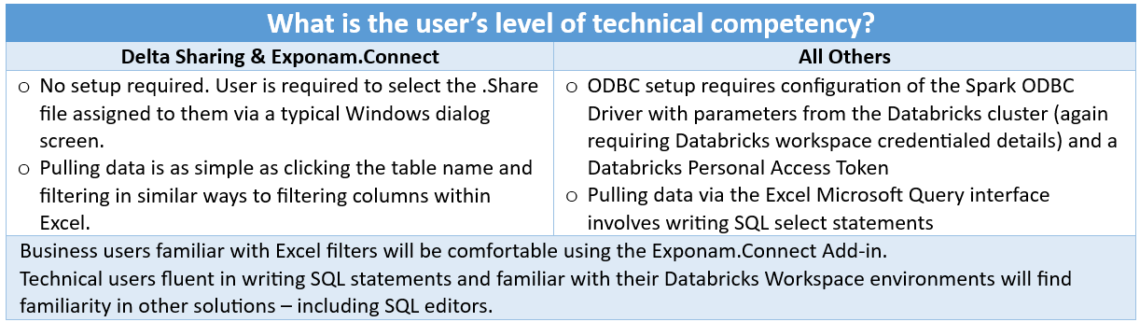
| UI / usability | Designed for business users. Controls and filters mirror Excel’s own conventions — no new mental model. Immediately familiar to anyone who lives in Excel. ▲ Exponam advantage for business users |
Designed by technologists. Even the basic table-select workflow resembles a BI platform’s report configuration interface — comfortable for technical users, carries a learning curve for typical business users. ▲ Databricks advantage for technical audiences |
| Platform scope | Databricks today. Snowflake and Azure Fabric on roadmap. ▲ Exponam advantage for multi-cloud |
Databricks only. |
What we observed in direct testing
In testing conducted for this comparison, both products were run against the same large enterprise-scale dataset. The results were unambiguous.
| Product / path | Rows returned | Outcome |
|---|---|---|
| Exponam.Connect — Delta Sharing | 2,879,789 | Complete. Full dataset retrieved successfully. ✓ |
| Exponam.Connect — SQL endpoint | 2,879,789 | Complete. Full dataset retrieved successfully. ✓ |
| Databricks Excel Add-in | 948,650 | Incomplete. Retrieval stopped at approximately one-third of the dataset and returned a non-descriptive error with no recovery path offered. |
Dataset: a large-scale enterprise transaction table available as a Delta Sharing trial dataset, containing approximately 2.88 million rows. Results from a single test run on standard hardware; individual results may vary by network conditions, warehouse configuration, and add-in version.
The Databricks add-in’s error was non-descriptive — no indication of whether it hit a row limit, a memory ceiling, or a query timeout, and no guidance on how to proceed. Organizations planning to use the add-in for large datasets should validate against their specific data volumes before deployment.
Designed for different users
The two products reveal their intended audiences the moment you use them. This is not a criticism of either — it is a useful signal for organizations deciding which to deploy and to whom.
Exponam.Connect was designed by business users for business users. The ribbon integration, task pane layout, and interaction model are all built to mirror what Excel users already know. Filters are applied exactly as they are on a native Excel sheet — same gestures, same mental model, no new vocabulary to learn. A finance analyst or operations manager can be productive within minutes of installation, without training or documentation. The design assumption is that Excel is home, and the add-in should feel like a natural extension of it.
The Databricks Excel Add-in was designed by technologists. Even using the basic table-select option — the simplest path through the product — the interface looks and feels like a BI platform’s report modification UI. It is parameter-driven, query-centric, and structured around concepts that are second nature to a data engineer or SQL analyst but unfamiliar to the typical Excel business user. There is nothing wrong with this for its intended audience. A Databricks-credentialed analyst who spends time in notebooks and SQL editors will feel at home. Someone who does not will not.
The cost question, with real numbers
The Databricks add-in carries no license fee, which looks attractive on first comparison. During testing, we ran four to five query imports in a single working day — casual, representative analyst use. The result: 16 DBU consumed, equating to $14.58 at the $0.70/DBU SQL Serverless list rate. For one analyst. One day. Light load.
Against that, here is what Exponam.Connect costs at the same user counts:
| User count | Exponam ($/mo) | Databricks @ $25/user † | Databricks @ $70/user ‡ |
|---|---|---|---|
| 100 users | $1,000 | $2,500 | $7,000 |
| 1,000 users | $5,000 | $25,000 | $70,000 |
| 10,000 users | $10,000 | $250,000 | $700,000 |
† Conservative floor estimate. ‡ Based on observed trial rate of 5 DBU/analyst/day at $0.70/DBU (SQL Serverless list) × 20 working days. Actual costs vary by query frequency, warehouse type, dataset size, and contracted DBU rates. Formula recalculation in shared workbooks can add further unplanned consumption.
At the observed trial rate, Exponam.Connect is 7× cheaper at 100 users, 14× cheaper at 1,000, and 70× cheaper at 10,000. Even the conservative $25/user floor produces multiples of 2.5×, 5×, and 25×. One caveat: for teams of fewer than 100 users, Exponam.Connect’s $1,000/month minimum is a meaningful consideration, and in that range the Databricks add-in’s absence of a license fee is a genuine advantage — if DBU consumption is carefully monitored.
=DATABRICKS.Table() or =DATABRICKS.SQL() lives as a formula in the worksheet. Excel formula recalculation — triggered by workbook operations, third-party add-ins, or Ctrl+Alt+F9 — can silently re-execute those queries against a running SQL warehouse. In workbooks that circulate widely, this adds unbudgeted compute spend that is difficult to detect until the invoice arrives. Exponam.Connect imports data as static cell values; refresh is managed entirely through the ribbon and is not affected by any Excel recalculation event.
Where Databricks has a genuine advantage
We said we would be honest, so here it is.
Small teams with existing Databricks credentials. If your team is fewer than 100 people, already operating inside a Databricks workspace, and primarily running SQL-scale queries rather than million-row imports, the Databricks add-in is reasonable. No additional license, solid SQL functionality, the same Unity Catalog governance your team already uses.
Mac-first organizations. On macOS, both products use the Office Web Add-in framework and the picture is more balanced. Exponam.Connect’s Delta Sharing cost advantage still applies, but the VSTO performance advantage does not. And Exponam.AI and the advanced SQL editor are not yet available on Exponam.Connect’s Mac edition. Mac-heavy deployments should evaluate both products carefully.
Platform confidence. Databricks is a $62B company releasing a first-party product. Enterprises weigh vendor stability and support structure, and Databricks carries weight in that evaluation.
What comes next from Exponam
Databricks’ entry does not change our roadmap — it confirms it. Three capabilities currently in development:
Natural language / AI query. Users will be able to describe their data need in plain English and receive governed, reproducible results — with a private or BYO LLM option for regulated environments where data cannot leave controlled infrastructure.
Automatic path optimization. AI-driven routing will select between Delta Sharing and the SQL endpoint on each query, optimizing automatically for cost and performance. Users won’t need to choose — the system will.
Multi-cloud expansion. Snowflake and Azure Fabric support are on the near-term roadmap. Databricks will build a good connector for Databricks data. They will not build one for Snowflake. We will.
The bottom line
Databricks entering the space is good news for the market. It validates the problem and raises awareness that governed, no-code lakehouse data access from Excel is available. Some of that awareness will land on their product. Some will land on ours.
For organizations with more than 100 users, Windows-primary deployments, cost sensitivity at scale, external data sharing needs, or multi-cloud environments: Exponam.Connect is the stronger choice on the merits. For small teams already inside Databricks’ ecosystem who need light-duty access: the Databricks add-in is a reasonable starting point — with the caveat that data volume limits and DBU consumption should be validated before any broader rollout.
The full technical comparison — covering installation, architecture, performance, cost, governance, usability, and roadmap in depth — is available below.
Full Technical White Paper
Exponam.Connect vs. the Databricks Excel Add-in — comprehensive comparison. March 2026.
© 2026 Exponam, LLC · exponam.com · info@exponam.com · +1.646.360.0110
Exponam is a Databricks Validated Technology Partner